Undergraduate research · Virginia Tech · 2021

Hubbard Model

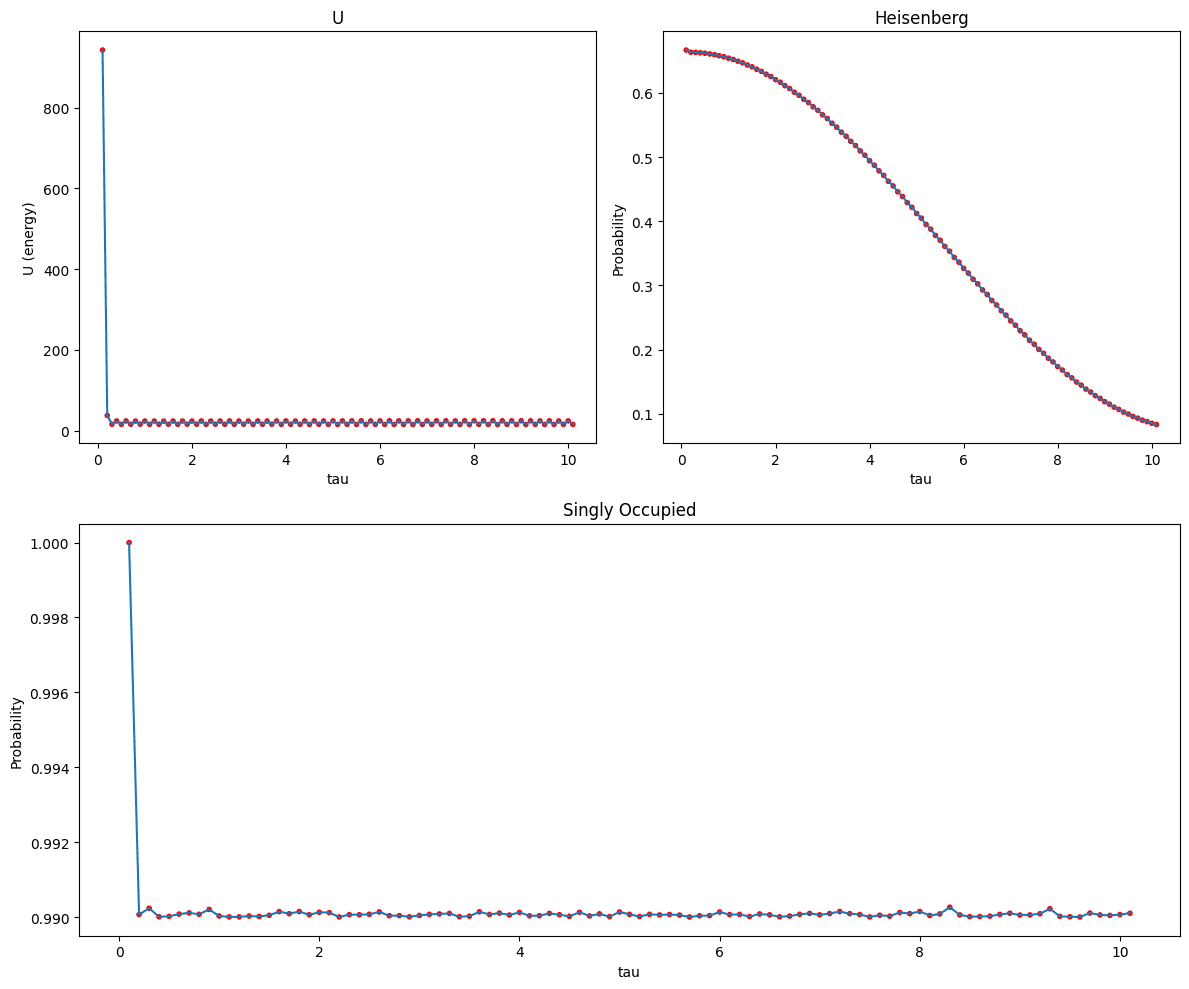
This page is a summary of the undergraduate research I did with Dr. Vito Scarola (2021). Our goal was to create code that simulated the three-site Hubbard Model and find solutions that minimize U(t) while keeping the system in a singly occupied state (or the Heisenberg state). I was able to accomplish this for the n and n,n-site Hubbard Model.

The Hubbard Model is useful in quantum computing when very cold particles are trapped in a laser lattice. To perform computational operations on these particles, we need them to be in singly occupied states. This research aims to do that while minimizing the energy input.

From Wikipedia, Hubbard Model:

The Hubbard model is a useful approximation for particles in a periodic potential at sufficiently low temperatures... and long-range interactions between the particles can be ignored.

View the code on GitHub →See ExampleScript.ipynb for more solutions

Dr. Vito Scarola
Dr. Vito Scarola
Garrett Stoll
Garrett Stoll

The Hamiltonian

H=−t∑<i,j>,σ(ci,σ†cj,σ)+U∑ini,↑ni,↓+μ∑i,σ(ni,↑+ni,↓) H= -t \sum_{<i,j>,\sigma} \bigg( c_{i,\sigma}^\dagger c_{j,\sigma} \bigg) + U \sum_{i} n_{i,\uparrow} n_{i,\downarrow} + \mu \sum_{i,\sigma} \bigg( n_{i,\uparrow} + n_{i,\downarrow} \bigg)

Where

tt - hopping parameter (tunneling amplitude)

ci,σ†c_{i,\sigma}^\dagger - creation operator at site i with spin σ\sigma

cj,σc_{j,\sigma} - annihilation operator at site j with spin σ\sigma

UU - on-site interaction energy

ni,↑ni,↓n_{i,\uparrow} n_{i,\downarrow} - number operator for doubly occupied sites

μ\mu - chemical potential

In matrix form

H=[U0−μ−t(c0,σ†c1,σ)⋯−t(c0,σ†cn,σ)−t(c1,σ†c0,σ)U1−μ⋱⋮⋮⋱⋱−t(cn−1,σ†cn,σ)−t(cn,σ†c0,σ)⋯−t(cn,σ†cn−1,σ)Un−μ] H = \begin{bmatrix} U_{0} - \mu & -t(c_{0,\sigma}^\dagger c_{1,\sigma}) & \cdots & -t(c_{0,\sigma}^\dagger c_{n,\sigma}) \\ -t(c_{1,\sigma}^\dagger c_{0,\sigma}) & U_{1} - \mu & \ddots & \vdots \\ \vdots & \ddots & \ddots & -t(c_{n-1,\sigma}^\dagger c_{n,\sigma}) \\ -t(c_{n,\sigma}^\dagger c_{0,\sigma}) & \cdots & -t(c_{n,\sigma}^\dagger c_{n-1,\sigma}) & U_{n} - \mu \\ \end{bmatrix}

Ui=0U_i=0 if ψi\psi_i is a singly occupied state.

We set μ=0\mu=0, t=1t=1, and the spins constant.

The nine possible states are

∣↑↓↑∣∣↑↓ ↑∣∣ ↑↓↑∣∣↑↑↓∣∣↑↓↑ ∣∣↑ ↑↓∣∣↓↑↑∣∣↑↑↓ ∣∣ ↑↑↓∣ \begin{matrix} |\uparrow \quad \downarrow \quad \uparrow| & |\uparrow\downarrow \quad \ \quad \uparrow| & |\ \quad \uparrow\downarrow \quad \uparrow | \\ |\uparrow \quad \uparrow \quad \downarrow| & |\uparrow\downarrow \quad \uparrow \quad \ | & |\uparrow \quad \ \quad \uparrow\downarrow| \\ |\downarrow \quad \uparrow \quad \uparrow| & |\uparrow \quad \uparrow\downarrow \quad \ | & |\ \quad \uparrow \quad \uparrow\downarrow| \\ \end{matrix}

Solutions

Solution plot: Minimize U